Bookkeeping Best Practices for Hanover, PA Small Businesses: A 2026 Checklist
Bookkeeping Best Practices for Hanover, PA Small Businesses: A 2026 Checklist
Last Tuesday at 10 PM, a Hanover boutique owner sat staring at a stack of 24 unorganized invoices, wondering if her personal and business expenses had finally become an inseparable knot. It's a heavy feeling that 40% of small business owners know well; the nagging fear that one wrong click could lead to a PA state tax headache. Implementing solid bookkeeping best practices is the only way to lift that weight and ensure your business remains "cleanup-ready" for the 2026 tax season. You didn't start your company to become a full-time data entry clerk, and you certainly didn't sign up for the constant stress of DIY finances that still feel wrong.
We agree that your focus should stay on your passion and your customers, not on the fear of an IRS audit. This essential checklist is your roadmap to reclaiming your time and finding the professional clarity you deserve. We'll walk through the exact steps to separate your funds and create a repeatable monthly routine that works for your York County business. You're about to discover how a little organization leads to a lot of freedom and a much lighter tax season.
Key Takeaways
- Transform financial chaos into a calm sanctuary by adopting standardized bookkeeping best practices designed for the modern Hanover entrepreneur.
- Master a simple, action-oriented checklist of daily and weekly tasks that ensure you always have a clear, real-time view of your business’s health.
- Gain peace of mind by learning how to navigate Pennsylvania-specific obligations, like local EIT and sales tax, without the usual stress.
- Discover why choosing the right accounting method and tools, like QuickBooks Online, creates a solid foundation for your long-term success in the York area.
- Recognize the specific signs that it’s time to trade DIY spreadsheets for professional support, reclaiming your time and focus for what you love most.
Why Bookkeeping Best Practices Matter for Hanover Entrepreneurs
You've poured your heart into launching your startup in Hanover. Now, you face a mountain of receipts and a bank balance that doesn't tell the whole story. Adopting bookkeeping best practices isn't just about satisfying the IRS; it's about building a foundation for your dreams. These habits represent the standard methods of bookkeeping that ensure every penny is accounted for, allowing you to breathe easy at the end of the day. When your records are organized, that heavy weight of financial uncertainty simply vanishes.
Waiting until April to organize your files is a recipe for unnecessary stress. Research indicates that 82% of small businesses fail because of poor cash flow management. Implementing bookkeeping best practices through proactive monthly management saves you from the 25% surge in accounting fees typically charged for emergency year-end cleanups. In York County, local tax compliance adds another layer of complexity. Between the 1% Earned Income Tax (EIT) and local mercantile taxes, missing a deadline can trigger penalties that eat your profit margins before you've even hit your stride.
The Emotional Benefits of Financial Clarity
Financial chaos feels like a constant, low-grade fever. Moving to a state of clarity creates a "Thank Heavens" moment where the fog finally lifts. With organized numbers, you don't have to guess if you can afford that new piece of equipment or a second location on Broadway. You'll replace the annual "Tax Season Panic" with a calm confidence, knowing your filings are accurate and ready long before the deadline. This clarity gives you the freedom to focus on what you love about your business.
Avoiding the Pitfalls of Commingled Finances
Mixing personal and business expenses is the fastest way to invite legal trouble. In Pennsylvania, this mistake can lead to "piercing the corporate veil," which means your personal assets could be at risk if your business faces a lawsuit. To stay safe, follow these rules:
- Open a dedicated business checking account for all company revenue.
- Use a separate business credit card for every software subscription and supply run.
- Never pay for personal groceries or home utilities using your business funds.
If you need help setting up these systems, working with a bookkeeper in Hanover, Pennsylvania ensures your accounts remain strictly separate from day one, protecting both your business and your family's future.
Foundational Habits: Setting Up Your Bookkeeping Sanctuary
Your Hanover startup deserves to feel like a place of growth, not a source of constant stress. Establishing bookkeeping best practices early on creates the clarity you need to make confident decisions. It starts with choosing between cash and accrual accounting. While 85% of new service businesses prefer the simplicity of cash accounting, accrual accounting provides a clearer picture of your long-term obligations. This choice dictates how you track every dollar that flows through your business.
Organizing your Chart of Accounts is the next step in building your sanctuary. This list acts as the skeleton of your financial system; it should reflect your specific industry needs rather than a generic template. Good records will help you track deductible expenses and stay prepared for tax season without the usual April panic. By using a digital document storage system, you can attach receipts directly to transactions, ensuring you never lose a deduction again.
Leveraging QuickBooks Online for Efficiency
QuickBooks Online is the preferred tool for Hanover entrepreneurs because it turns hours of manual work into minutes of review. By automating your bank feeds, you can categorize 90% of your transactions with just a few clicks. However, the software is only as good as its configuration. A professional QuickBooks Online setup prevents common errors that lead to messy books later. Seeking a partner with ProAdvisor certification ensures you have a guide who understands the nuances of the platform, giving you the freedom to focus on your clients.
Implementing Internal Controls
Internal controls provide a safety net for your hard-earned money. Even if you don't have a large team yet, creating a paper trail for every small expense prevents fraud and clerical errors. If you work with staff or contractors in York or Harrisburg, define their access levels strictly. Assigning different people to record and authorize payments protects your business from the 5% revenue loss that the average small firm experiences due to internal fraud. If you feel overwhelmed by these details, you can always connect with a partner who finds joy in the numbers so you don't have to.
The Master Checklist: Daily, Weekly, and Monthly Tasks
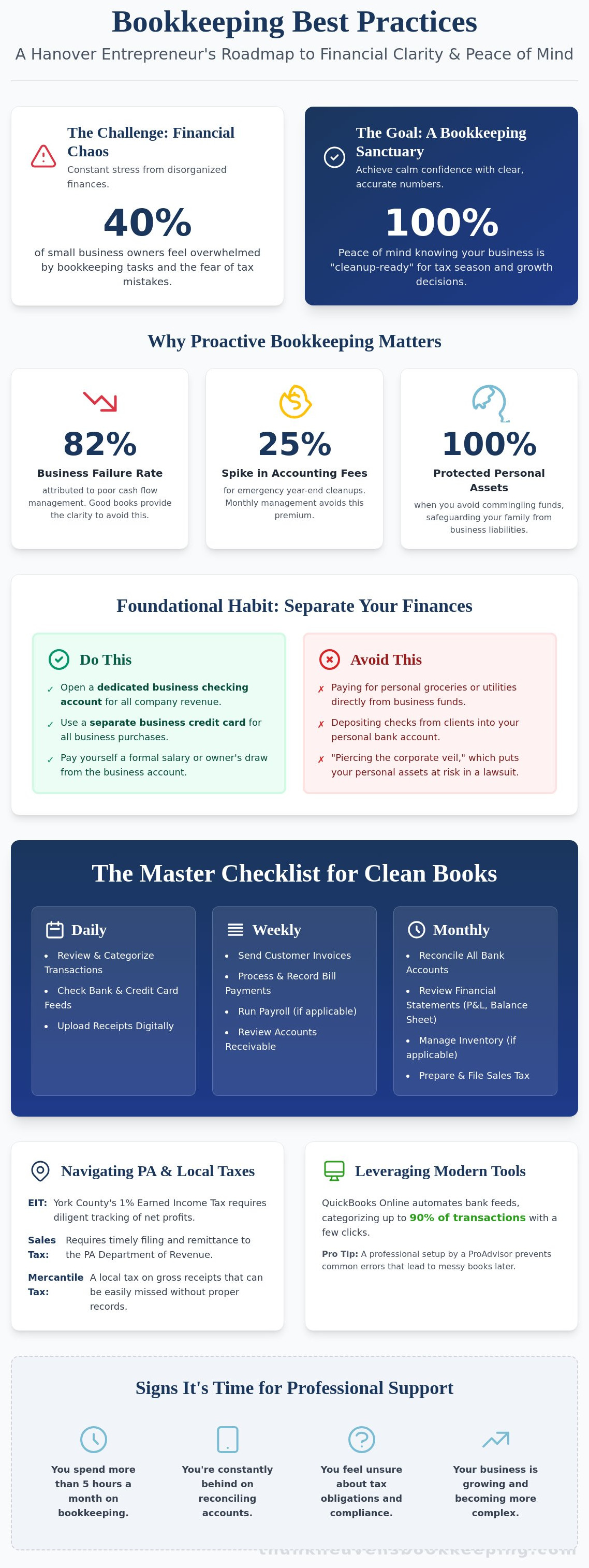
Establishing a rhythm for your finances transforms a chaotic pile of paper into a source of confidence. You've likely felt that familiar tug of anxiety when a receipt goes missing or a bank balance looks lower than expected. By breaking your bookkeeping best practices into manageable chunks, you reclaim your time and your peace of mind.
Your daily routine should take no more than five minutes. Use this time to capture receipts digitally and monitor your bank activity for any unusual transactions. On a weekly basis, dedicate an hour to recording customer payments and paying your own bills. This consistency prevents the end of month scramble that keeps so many entrepreneurs awake at night. A study by US Bank found that 82 percent of small business failures stem from poor cash flow management, so checking your weekly cash position is a vital safety net.
Quarterly tasks focus on your obligations to the state. You must review your estimated tax payments and ensure all PA state filings are accurate. The Pennsylvania Department of Revenue suggests that implementing a formal record keeping system for a small business is a legal requirement that protects you during audits. Staying ahead of these deadlines means you'll never face those heavy late-payment penalties.
The Monthly Reconciliation Ritual
Reconciliation is the heart of financial integrity. It's the process of ensuring your accounting software matches your bank and credit card statements exactly. This is where bookkeeping best practices truly shine. Follow these steps each month:
- Download your monthly statements as soon as they're available.
- Compare every transaction in your software to the statement.
- Identify and resolve discrepancies, such as bank fees or missed interest payments.
- Verify that your ending balances match to the penny.
If these steps feel overwhelming, remember that a bookkeeper in Hanover, Pennsylvania can handle this ritual for you. Having a professional eye on your books ensures that errors are caught before they become expensive problems.
Reviewing Your Financial Statements
Once your books are reconciled, you gain access to the story of your business. Your Profit and Loss (P&L) statement shows exactly where your revenue is going. If your office supplies or software subscriptions jumped by 15 percent last month, the P&L will highlight that trend immediately. Your Balance Sheet acts as a health check, showing what you own versus what you owe. Reviewing these documents monthly gives you the clarity to make bold, informed decisions for your startup's future.
Navigating Pennsylvania-Specific Bookkeeping Requirements
Running a startup in Hanover means you're answering to more than just the IRS. Pennsylvania has unique tax layers that can feel like a heavy weight on your shoulders if you aren't prepared. One of the most vital bookkeeping best practices is staying ahead of these state-level demands before they become urgent problems. You deserve to focus on your vision, not on deciphering complex state forms at midnight.
If you sell taxable goods or specific services, you're responsible for the 6% Pennsylvania sales tax. You'll need to track these collections meticulously and file returns through the myPATH portal. Even a minor oversight can lead to a 5% monthly penalty for late filing. Keeping your sales records organized in real-time ensures you always have the funds set aside when the Department of Revenue comes calling.
Managing contractors adds another layer of responsibility. Pennsylvania requires you to file Form 1099-NEC for any non-employee you paid $600 or more during the calendar year. These must be submitted by January 31st. Falling behind on these filings doesn't just invite state audits; it creates unnecessary friction with the talented partners who help your business grow.
Hanover and York County Local Tax Nuances
Startups in the 17331 zip code typically report to the York Adams Tax Bureau (YATB). You must withhold the local Earned Income Tax (EIT), which is 1% for residents of Hanover Borough and Penn Township. We recommend setting up a specific payroll liability account to track these funds. A "big box" national firm might miss these hyper-local shifts, but a bookkeeper in Hanover, Pennsylvania understands exactly which codes apply to your specific street address.
Preparing for Year-End in the Keystone State
Your goal is to have your books "Tax Ready" by December 31st. This means every transaction is reconciled and every receipt is digitally filed. One of the most effective bookkeeping best practices is gathering W-9 forms from every vendor the moment you hire them. Don't wait until the January rush to track down tax IDs. When your data is organized by year-end, the transition into tax season feels like a gentle breeze rather than a storm. You can step into the New Year with total confidence in your financial health.
If the thought of local tax filings makes you feel overwhelmed, let us carry that burden for you. Explore our services to see how we bring clarity and relief to Hanover business owners.
When to Move from DIY to Professional Bookkeeping Support
Starting a business in Hanover often begins with a single spreadsheet. However, as you scale, that DIY approach can quickly become a source of anxiety rather than a tool for growth. Research from the Small Business Administration indicates that 82% of businesses fail because of poor cash flow management. If you're spending more than 5 hours every week wrestling with reconciliations or finding that your bank balance never quite matches your records, you've likely reached the limit of DIY bookkeeping.
Hiring a professional isn't just an expense; it's a strategic investment in your sanity. Consider the math: if your billable rate is $150 per hour and you spend 10 hours a month on manual data entry, you're effectively paying $1,500 for bookkeeping that might still contain errors. Handing these tasks to a specialist provides an immediate return on investment by freeing you to focus on high-value client work. It's also essential to find a partner who understands the unique workflows of service-based businesses, where tracking billable hours and project expenses is vital for profitability.
The "Thank Heavens" Moment: Outsourcing Your Books
Transitioning to a monthly service feels like a weight lifting off your shoulders. A certified QuickBooks ProAdvisor doesn't just take over the data entry; they perform a deep-dive cleanup of your historical files. This process identifies duplicate entries, unapplied payments, and miscategorized expenses that have likely skewed your tax filings for the last 12 to 18 months. By implementing professional bookkeeping best practices, your specialist ensures every transaction is mapped correctly, giving you a fresh start and total confidence in your numbers. You finally get your weekends back to enjoy life in Hanover instead of staring at a screen.
Next Steps for Financial Freedom
Taking control of your numbers is the fastest way to achieve peace of mind. You can start by scheduling a consultation to assess your current bookkeeping health and identify areas where you might be losing money. Thank Heavens Bookkeeping proudly serves the Hanover, York, and Harrisburg communities, providing the local expertise you need to thrive. Adopting professional bookkeeping best practices isn't about adding more work to your plate; it's about creating the freedom to lead your business with clarity. Your finances don't have to be a source of stress anymore.
Take Control of Your Hanover Business Finances Today
Mastering these bookkeeping best practices ensures your York County business avoids common 10% late filing penalties while maintaining total transparency for the 2026 tax season. By establishing daily habits and performing thorough monthly reconciliations, you build a foundation of clarity that supports long-term growth. You don't have to carry the weight of complex spreadsheets or Pennsylvania-specific compliance on your own.
As a Certified QuickBooks Online ProAdvisor with deep roots in Hanover and York, I specialize in performing 24-month account cleanups and precise monthly management. It's time to trade your financial stress for the peace of mind that comes with an organized back office. Ready for financial clarity? Let us handle your books so you can breathe a sigh of relief. View our services today.
You've worked hard to build your business; you deserve a partner who cares about your success as much as you do. Let's make 2026 the year you finally feel light, organized, and completely in control of your journey.
Frequently Asked Questions
What are the 3 most important bookkeeping best practices for beginners?
The 3 most important bookkeeping best practices for Hanover beginners are separating personal funds, tracking every expense, and setting a weekly finance date. Keeping your business costs in a dedicated account prevents a messy tax season. When you commit to these habits, you gain the clarity needed to grow. It's the first step toward that "thank heavens" feeling of having everything under control and organized.
How often should I reconcile my bank accounts in QuickBooks?
You should reconcile your bank accounts in QuickBooks at least once every 30 days. This essential process ensures your software matches your actual bank statement to the penny. Regular monthly reconciliation catches the 20% of banking errors that often go unnoticed by busy owners. It provides the freedom to make business decisions based on real, verified numbers rather than stressful guesses. You'll sleep better knowing your data is accurate.
Do I really need to keep physical receipts if I use accounting software?
You don't need to keep physical paper receipts if you store high quality digital images in your software. The IRS has accepted digital records since Revenue Procedure 97-22 was released in 1997. This shift saves you from the stress of "shoebox accounting" and cluttered desks. Digital files are easier to search and won't fade over the 3 to 7 years you're required to keep them for audit purposes.
What is the difference between a bookkeeper and an accountant in PA?
A bookkeeper manages your daily financial transactions while a PA accountant focuses on tax preparation and long term strategy. Think of your bookkeeper as the person who keeps the engine running smoothly every day. In Pennsylvania, CPAs must complete 80 hours of training every 2 years to stay certified. Having both roles filled gives your Hanover business a complete financial safety net and a path to true professional warmth.
How do I know if my books need a professional cleanup?
Your books need a professional cleanup if your bank balance hasn't matched your software for 90 days or more. Uncategorized transactions totaling more than $500 are another clear sign of trouble. Professional help restores your confidence by fixing historical errors that cause anxiety. It moves you from financial chaos to a state of organized advocacy for your startup's future success. We love finding the joy in those messy details.
Can I do my own bookkeeping if I have a small business in Hanover?
You can certainly handle your own bookkeeping when you're first starting your Hanover business. Many local owners spend about 5 hours a week managing their own ledgers to save on initial costs. However, implementing professional bookkeeping best practices early on prevents expensive mistakes during tax season. As your annual revenue grows past $100,000, you'll likely find that your time is more valuable when spent on daily operations and client growth.
What specific PA taxes should I be tracking in my bookkeeping?
You must track the 6% Pennsylvania sales tax and the 3.07% flat state income tax in your records. Hanover startups also need to account for the 1% local Earned Income Tax collected by York County. Tracking these specific figures ensures you aren't surprised by a large bill in April. It's about creating a predictable, calming rhythm for your business finances so you can focus on your passion instead of paperwork.
Is QuickBooks Online better than a spreadsheet for a solo entrepreneur?
QuickBooks Online is more effective than a spreadsheet because it reduces manual data entry time by roughly 50%. Spreadsheets often lead to broken formulas that can hide significant financial leaks. Cloud software provides a secure sanctuary for your data with automatic backups every single day. You'll feel a sense of relief knowing your numbers are accurate, secure, and accessible from your phone or laptop whenever you need clarity.