What if your bookkeeping wasn't a monthly chore you dread, but a sanctuary of clarity that reveals exactly where your business is leaking cash? You might feel like you're drowning in receipts or feeling anxious about the new $2,000 reporting threshold for 1099-NEC forms. It's natural to seek
Small Business Bookkeeping Tips to Save Time and Increase Profit when 31% of owners cite inflation as their top challenge in 2026. You deserve to know if you're actually making a profit without spending every weekend staring at a spreadsheet.
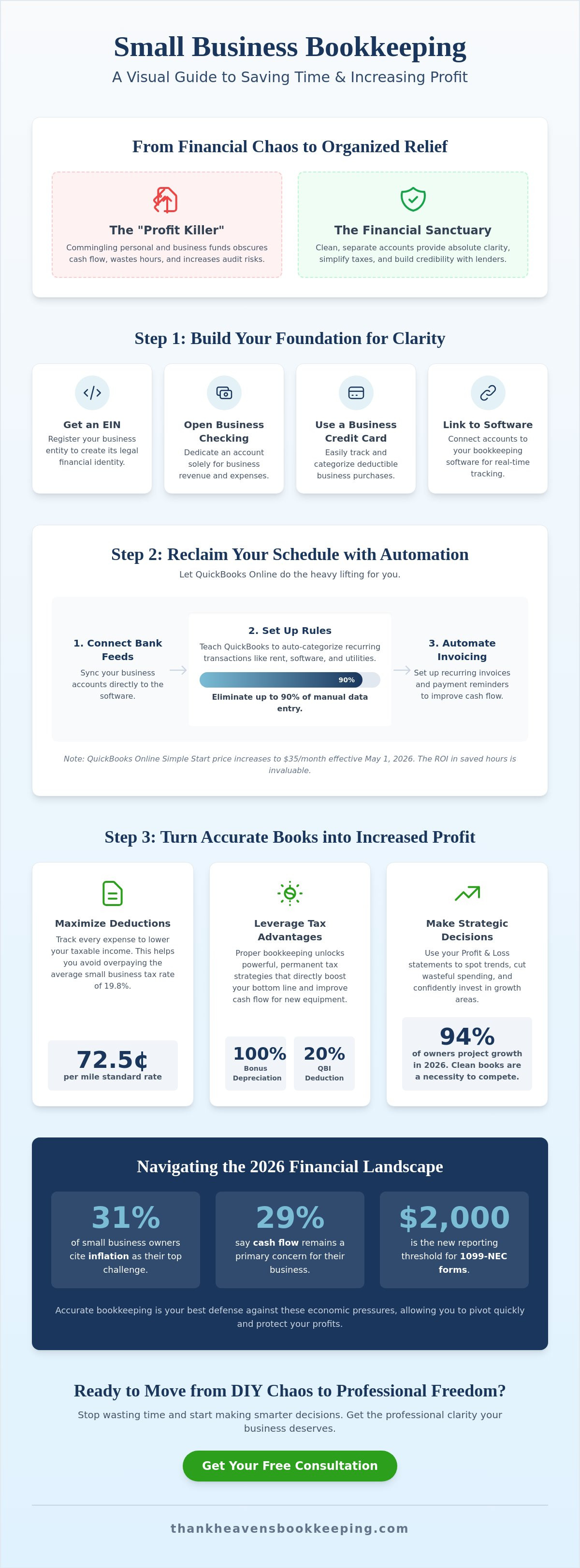
In this guide, we'll help you reclaim your schedule and your peace of mind. We'll show you how to navigate the May 1, 2026 QuickBooks price increases and leverage the permanent 20% QBI deduction to your advantage. You'll learn how to set up automated systems that run in the background, providing the clear financial reports you need to lead with confidence. From maximizing the 72.5 cent mileage rate to utilizing 100% bonus depreciation, we're moving you from financial chaos to a state of organized relief and a true thank heavens moment.
Key Takeaways
- Stop the "profit killer" of commingling funds to build a foundation of financial sanctuary and absolute clarity.
- Reclaim your freedom by mastering these
Small Business Bookkeeping Tips to Save Time and Increase Profit through QuickBooks Online automation and smart bank feeds.
- Turn your Profit and Loss statements into a strategic advantage by spotting trends and eliminating wasteful spending before it impacts your bottom line.
- Shift from "DIY chaos" to professional clarity by understanding when the opportunity cost of managing your own books is holding your business back.
The Foundation of Financial Clarity: Why Mindset and Separation Matter
Think of your bookkeeping as a financial sanctuary rather than a tax season obligation. While many view it as a dry recording of standard methods of bookkeeping, it's actually the heartbeat of your business's health. When you shift your mindset from avoiding your numbers to advocating for them, you gain the clarity needed to make bold decisions. With 94% of small business owners projecting growth in 2026, having a clean financial foundation isn't just a preference; it's a competitive necessity. One of the most effective
Small Business Bookkeeping Tips to Save Time and Increase Profit is to treat your business finances with the respect they deserve by giving them their own dedicated space.
The Emotional and Financial Cost of Commingling
Commingling is the act of mixing personal and business funds in a single account, and it's a practice that leaves your business vulnerable to IRS audits and hides your true profit margins. It's the number one profit killer because it obscures your cash flow. If you're manually sorting through a year's worth of personal bank statements to find one business expense, you're losing hours of billable time. This chaos also makes professional tax preparation significantly more expensive, as your accountant must spend extra hours untangling your life from your work. By keeping things separate, you simplify your QuickBooks reconciliation and reduce the anxiety that often comes with tax deadlines like the January 31, 2026, W-2 and 1099-NEC filing date. Accurate records ensure you aren't overpaying on the average small business tax rate of 19.8% by missing legitimate expenses.
Setting Up Your Business for Success
Establishing a dedicated business checking account and a separate business credit card is your first step toward professional freedom. This clear boundary does more than just organize your receipts; it builds vital credibility with lenders and vendors. If you plan to apply for financing, lenders will want to see clean, separate records to verify your revenue growth or your ability to handle rising input costs, which affected 77% of firms in 2025. To get started, you should:
- Register your business entity and obtain an EIN.
- Open a business checking account specifically for all revenue and operating expenses.
- Apply for a business credit card to capture deductions like the 72.5 cent per mile standard mileage rate.
- Link these accounts directly to your bookkeeping software for real-time tracking.
This simple act of separation creates a "thank heavens" moment of clarity the second you open that first account. It allows you to use professional bookkeeping services to their full potential, ensuring every dollar is accounted for and your bottom line is protected. When your accounts are organized, the fear of the unknown vanishes, replaced by the confidence that you are truly in control of your financial future.
Saving Time Through Smart QuickBooks Online Automation
Efficiency is the bridge between drowning in paperwork and enjoying the freedom you started your business for. While manual data entry used to be a requirement, modern software has transformed the landscape. QuickBooks Online remains the gold standard for service-based businesses because it acts as a centralized hub for your financial life. Even with the QuickBooks price increases effective May 1, 2026, where Simple Start moves to $35 per month, the return on investment in saved hours is undeniable. Implementing these
Small Business Bookkeeping Tips to Save Time and Increase Profit starts with letting the software do the heavy lifting for you.
Leveraging bank feeds is the most immediate way to reclaim your schedule. By connecting your dedicated business accounts directly to the software, you can eliminate up to 90% of manual data entry. The real magic happens when you use "Rules" to teach the system how to handle recurring transactions. For example, you can set a rule so that every time your monthly software subscription hits your account, QuickBooks automatically categorizes it and matches it to a receipt. This allows you to maintain proper bookkeeping without touching a single key. It turns a weekend of work into a few minutes of steady, calming review.
Cash flow remains a top challenge for 29% of small businesses in 2026. Automated invoicing helps solve this by reducing the "Accounts Receivable" headache. You can set up recurring invoices for long-term clients and enable automatic payment reminders for those who might be a little forgetful. This ensures money flows into your bank account faster, providing the "thank heavens" relief of a healthy balance sheet.
Customizing Your Chart of Accounts
The Chart of Accounts is the DNA of your financial reporting. A generic setup often leads to confusing, cluttered reports that don't reflect your specific industry needs. A professional QuickBooks Online Setup ensures your accounts are structured to provide meaningful insights from day one. This tailored approach prevents the need for expensive "cleanup" projects later and makes your year-over-year comparisons actually useful for growth.
Automating the Paper Trail
Digital record-keeping is your best defense against audit anxiety. Tools like Dext or the built-in QuickBooks Receipt Capture allow you to go paperless the moment a transaction occurs. Follow the "one-touch" rule: snap a photo of the receipt on your phone immediately, and let the system attach it to the transaction. This creates a ready-made audit trail that lives in the cloud, giving you total confidence that you're prepared for anything. If you feel overwhelmed by the initial setup, you can always schedule a consultation to get your automation running smoothly.
How Accurate Bookkeeping Directly Increases Your Profit
Accurate bookkeeping is the difference between guessing your margins and knowing them with absolute certainty. While the first two sections focused on organization and automation, this is where your financial data transforms into a growth engine. Your Profit and Loss (P&L) statement serves as a strategic roadmap, highlighting exactly where your revenue is flowing and where it might be leaking. By implementing these
Small Business Bookkeeping Tips to Save Time and Increase Profit, you move from simply recording history to actively shaping your business's future.
One of the most powerful tools at your disposal is the Year-over-Year (YoY) comparison. With 77% of small employer firms reporting challenges from rising input costs in 2025, looking back at historical data helps you spot dangerous trends before they erode your bottom line. If your software shows that your operating expenses are climbing faster than your revenue, you have the objective evidence needed to raise your rates with total confidence. You can also utilize "class tracking" to categorize different revenue streams. This reveals which of your service-based businesses offerings are truly profitable and which ones are actually costing you money to fulfill.
Identifying "Ghost" Expenses and Leaks
Monthly reconciliations are your primary defense against "ghost" expenses. These are the forgotten $50 software subscriptions, double-billing errors, or unauthorized charges that quietly drain your bank account. Catching just two or three of these errors can save you hundreds of dollars annually. We advocate for a "Profit First" approach where you analyze your margins every single month. By scrutinizing your Cost of Goods Sold (COGS), you ensure your current pricing structure covers your true overhead and accounts for the 31% inflation rate many owners are currently facing in 2026.
Forecasting for Growth and Tax Savings
Clean books allow you to move from reactive payments to proactive planning. When your data is organized, you can use historical patterns to predict future cash flow needs, helping you navigate the "dry spells" that 29% of small businesses struggle with. This clarity is especially vital as you approach the April 15, 2026, tax deadline. Instead of being surprised by a bill based on the average small business tax rate of 19.8%, you can work with your professional partner to identify deductions like the 50% small business childcare credit early. This level of foresight provides a profound sense of relief, knowing that your profit is protected and your growth is sustainable.
The Monthly Ritual: A Step-by-Step Workflow for Owners
Imagine a world where the end of the month isn't a source of anxiety, but a quiet hour of reflection and relief. Transitioning from a state of dread to a predictable ritual is one of the most transformative
Small Business Bookkeeping Tips to Save Time and Increase Profit. By setting a recurring date with your numbers, you move away from financial chaos and into a state of steady control. This isn't just about data entry. It's about creating a sanctuary where you can clearly see the fruits of your labor and make decisions with a calm mind.
Your monthly workflow should follow a logical, calming sequence to ensure nothing slips through the cracks. First, reconcile all bank and credit card accounts to the penny. This step ensures that every transaction in your software matches your bank's reality. Second, review and categorize any "Uncategorized" transactions in QuickBooks to maintain the integrity of your reports. Third, audit your "Accounts Receivable" and send friendly, automated reminders for any unpaid invoices. Finally, generate and review your monthly Balance Sheet and Profit and Loss statement. These reports provide the "thank heavens" moment of clarity you need to lead your business into the next month.
The Reconciliation Checklist
A reconciled account is the only way to truly trust your financial data. If your books don't match your bank statement, your reports are essentially fiction. Common errors, such as duplicate entries or missed bank fees, can snowball into major headaches if they aren't caught quickly. Following a monthly bookkeeping checklist provides a repeatable path to clarity. It allows you to catch mistakes early, ensuring your financial foundation remains solid and your audit anxiety stays low.
Managing Contractor Compliance (1099s)
Collecting W-9 forms before you issue the first payment to a contractor is a massive time-saver. For the 2026 tax year, the reporting threshold for Form 1099-NEC and 1099-MISC increases to $2,000. By tracking these payments monthly, you avoid the frantic January scramble to meet the January 31, 2026, filing deadline. This proactive habit makes tax season just another month on the calendar rather than a stressful event. If you'd rather spend your time growing your sales than chasing down contractor details, you can book a discovery call to see how we can handle this ritual for you.
When to Outsource: Moving from DIY Chaos to Professional Freedom
There comes a moment for every growing entrepreneur when managing the books feels less like a task and more like a heavy weight. You might find yourself staring at your screen late at night, wondering if the time you're spending is actually saving you money. Calculating your opportunity cost is the first step toward freedom. If your billable rate is $150 per hour and you spend five hours a month struggling with bank reconciliations, you've effectively spent $750 on a task that a professional could handle with greater accuracy. Embracing
Small Business Bookkeeping Tips to Save Time and Increase Profit often means recognizing that your greatest profit driver is your own expertise, not your ability to navigate a ledger.
A common hurdle for many owners is the fear that their books are "too messy" to show a professional. Please know that you don't need to fix your books before hiring help. An organized advocate finds joy in the very details that cause you stress. They can untangle months of data, ensuring you take full advantage of the $2.5 million Section 179 expensing limit or the 100% bonus depreciation available in 2026. This partnership transforms your financial records from a source of anxiety into a strategic advantage, protecting you from late fees and identifying missed deductions like the 72.5 cent per mile business mileage rate.
Signs You Have Outgrown DIY Bookkeeping
If you're more than three months behind on your reconciliations, a catch-up service is the fastest path to relief. Another clear sign is the inability to answer "Am I making money?" without spending hours in a spreadsheet. When you can't see your real-time cash flow, you risk making decisions based on old data. Professional Monthly Bookkeeping pays for itself in the peace of mind it provides, allowing you to focus on the 94% growth projected for small businesses in 2026. It moves you from a state of constant catching up to a place of proactive financial leadership.
Finding the Right Partner
When searching for a partner, look for a QuickBooks Online ProAdvisor who understands your specific industry. There's a significant difference between a data entry clerk and a strategic financial partner. A true partner doesn't just record transactions; they analyze your P&L to help you navigate the 20% QuickBooks price increases or the new $2,000 reporting threshold for 1099-NEC forms. We invite you to learn more about Thank Heavens Bookkeeping and our unique approach. We pride ourselves on being the meticulous, reliable partner who brings a "thank heavens" sense of clarity to your back office, so you can shine in your front-facing success.
Step Into Your Financial Sanctuary
You now have a clear roadmap to move from drowning in data to leading with absolute confidence. By establishing a firm boundary between your personal and business accounts and leveraging automated software, you've already laid the groundwork for long-term success. These
Small Business Bookkeeping Tips to Save Time and Increase Profit are designed to transform your monthly ritual into a source of peace rather than a weekend of dread. You deserve to know exactly where your money is going so you can focus on the growth you've worked so hard to achieve.
If you're still feeling the weight of messy books, remember that you don't have to untangle them alone. As a Certified QuickBooks Online ProAdvisor specializing in account cleanups and monthly reconciliations, I offer an empathetic, relief-oriented approach for service-based owners. I find joy in the details that cause you stress, acting as your organized advocate every step of the way. Let's move your business from financial chaos to a state of calm, predictable clarity.
Ready for a "Thank Heavens" moment? Schedule your free consultation today.
Your financial freedom is within reach, and we're here to help you claim it.
Frequently Asked Questions
How often should I reconcile my small business bank accounts?
You should reconcile your accounts at least once every month. This regular practice is a foundational habit for accurate financial reporting and is essential if you plan to secure financing from lenders. Monthly reconciliation allows you to catch double-billing errors or missed bank fees before they impact your cash flow, which was a top challenge for 29% of small businesses in 2026.
What is the best bookkeeping software for a service-based small business?
QuickBooks Online remains the gold standard for service-based businesses because of its robust automation and real-time reporting capabilities. As of May 1, 2026, pricing starts at $35 per month for Simple Start and goes up to $250 per month for the Advanced tier. This software provides the necessary tools to implement Small Business Bookkeeping Tips to Save Time and Increase Profit through smart bank feeds and automated invoicing.
Do I really need a separate bank account for my side hustle?
Yes, you absolutely need a dedicated business account to avoid the "Cardinal Rule" of commingling funds. Mixed accounts are a major profit-killer because they hide your true business performance and make tax preparation twice as expensive. Opening a separate account is the first step toward the "thank heavens" clarity that protects you during an IRS audit.
How can bookkeeping help me save money on taxes in 2026?
Organized bookkeeping ensures you capture every eligible deduction, such as the 72.5 cent per mile standard mileage rate or the 50% small business childcare credit. When your books are current, you can engage in proactive tax planning rather than reactive payments. This foresight helps you manage the average small business tax rate of 19.8% by identifying 100% bonus depreciation opportunities for qualifying equipment.
What is the difference between a bookkeeper and an accountant?
A bookkeeper focuses on the daily "ritual" of recording transactions, reconciling accounts, and maintaining organized records. They are your meticulous, daily partners in financial clarity. Accountants typically take that data to perform high-level tax strategy, filing, and complex auditing. Think of a bookkeeper as the person who keeps the engine running smoothly and an accountant as the one who plans the long-distance route.
What should I do if my QuickBooks accounts haven’t been touched in a year?
You should seek a professional "Catch-up" or "Cleanup" service immediately to reclaim your peace of mind. There is no need to feel embarrassed or try to fix the mess yourself before reaching out to an expert. A professional partner finds joy in untangling these details and can move you from financial chaos to total organization in a fraction of the time it would take you alone.
How do I know if I need to send a 1099 to a contractor?
For the 2026 tax year, you must issue a Form 1099-NEC if you paid a contractor $2,000 or more for services. It is a critical time-saver to collect a completed W-9 form before you issue the first payment to any vendor. This proactive habit ensures you meet the January 31, 2026, filing deadline without a frantic last-minute scramble for information.
Can I do my own bookkeeping or is it too risky for a beginner?
You can certainly manage your own books, but you must weigh the time spent against the potential for errors. Beginners often struggle with
Small Business Bookkeeping Tips to Save Time and Increase Profit like setting up proper class tracking or correctly recording the Social Security wage base of $184,500. If the "opportunity cost" of your time is higher than the cost of a professional, outsourcing provides an immediate return on investment.