Balance Sheet for Small Business: A Hanover, PA Guide to Financial Clarity
Balance Sheet for Small Business: A Hanover, PA Guide to Financial Clarity
On March 15, 2023, a small business owner in Hanover discovered their QuickBooks data was so messy they couldn't explain their company's value to a potential lender. You probably recognize that sinking feeling in your stomach when tax season approaches and you're unsure if your numbers are actually right. It's exhausting to work so hard yet feel completely blind to the true value of what you've built. Mastering a balance sheet for small business is the first step toward trading that anxiety for a sense of profound relief. You deserve to know exactly where your hard work is going.
I understand the weight of messy books, but I promise that financial clarity is within your reach. This guide will show you how to master your balance sheet to gain total financial confidence and move from chaos to clarity. We'll break down the simple relationship between what you own and what you owe, giving you the tools to make growth decisions with absolute certainty. By the end, you'll feel the weight lift as your financial picture finally comes into focus.
Key Takeaways
- Master the fundamental equation of assets, liabilities, and equity to transform your financial chaos into a clear, organized snapshot of success.
- Learn to distinguish between what you own and what you owe to ensure your Hanover or York business is built on a stable, long-term foundation.
- Discover why a healthy profit and loss statement isn't enough and how a balance sheet for small business reveals the true strength of your financial position.
- Identify the critical red flags and liquidity ratios that signal whether your business is truly ready for growth or heading toward a cash crunch.
- Experience the relief of professional clarity by learning how a local bookkeeping expert can help you achieve total financial peace of mind.
What is a Balance Sheet for Small Business Owners in Hanover?
Checking your bank balance at 2:00 AM doesn't give you the full story of your company. It's a habit 61% of small business owners fall into, but it often leads to a false sense of security or unnecessary panic. A balance sheet for small business owners acts as a sanctuary of clarity. It provides a comprehensive definition of a balance sheet by showing you exactly what you own and what you owe at a single point in time. When you look at this document, you aren't just looking at numbers; you're seeing the foundation of your hard work. This clarity replaces the weight of "not knowing" with a profound sense of relief.
The Snapshot Concept: Why Date Matters
Unlike a Profit and Loss statement that covers a range of time, a balance sheet is "As Of" a specific date. Think of it as a frozen frame in a movie. For your 2024 tax filings in Hanover, PA, your year-end balance sheet from December 31, 2023, is the most critical document you'll provide to your CPA. Monthly internal reviews help you catch errors early, while annual reports satisfy the IRS and local lenders. If you're working with a bookkeeper in Hanover, Pennsylvania, they'll ensure these snapshots are crystal clear so you can breathe easier during tax season.
The Accounting Equation Made Simple
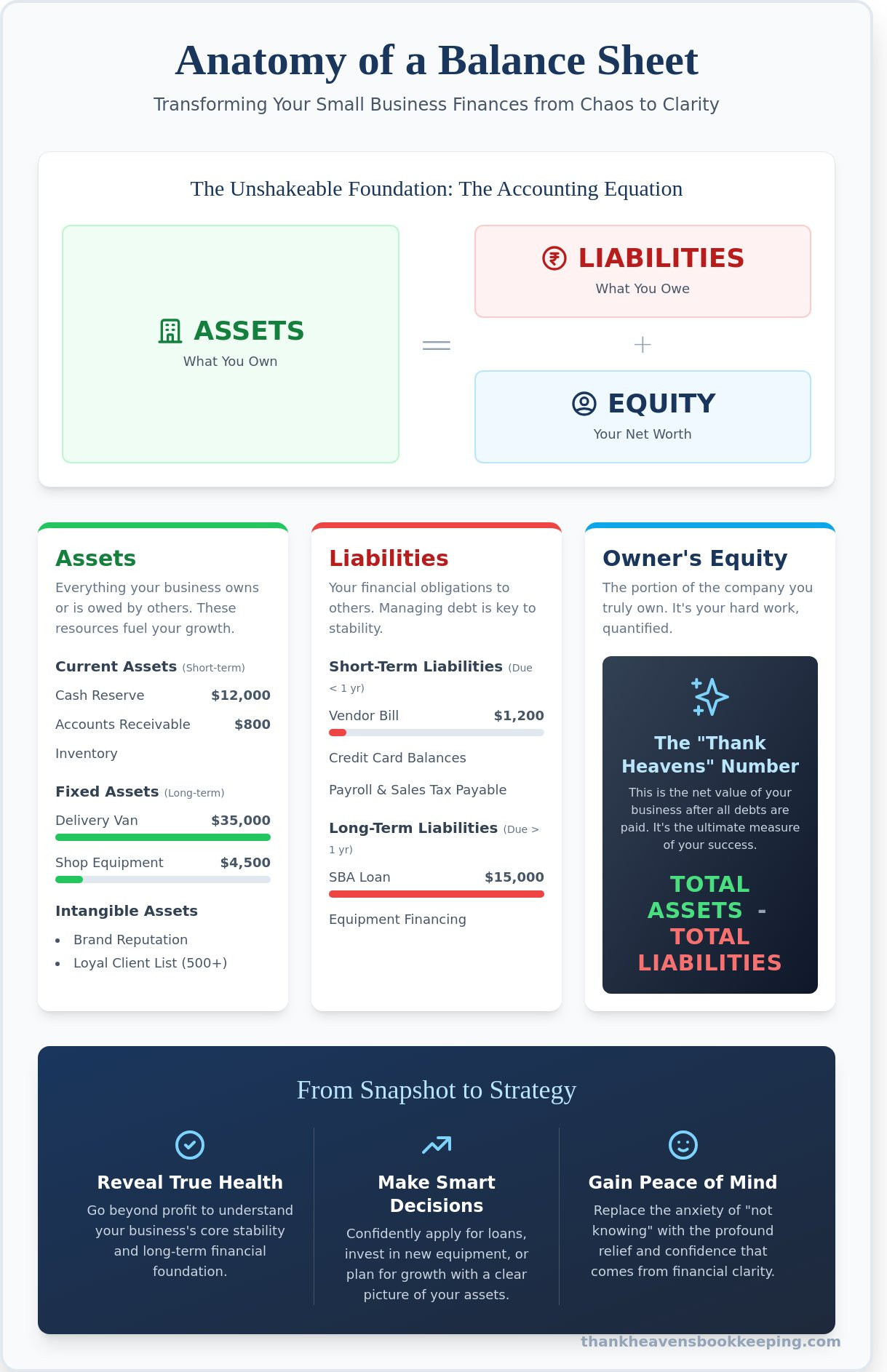
The magic of an organized balance sheet for small business happens through one simple equation: Assets = Liabilities + Equity. This balance ensures your books are accurate and gives you the confidence to make big decisions. Here is how those pieces fit together for your business:
- Assets: These are things you have or what is owed to you. This includes the $4,500 of equipment in your shop, your $12,000 cash reserve, or the $800 an York County client still needs to pay you.
- Liabilities: This is what you owe to others. It might be a $15,000 SBA loan, a $1,200 bill from a local vendor, or the payroll taxes you'll send to the IRS next month.
- Equity: This is the "thank heavens" number. It's the value that is left for you, the owner, after every debt is settled.
Seeing your business health in one document replaces financial chaos with a steady, predictable rhythm. It's a transformative moment for any entrepreneur to move from guessing their worth to seeing it documented on paper. When your assets outweigh your liabilities, you aren't just running a business; you're building a legacy with confidence.
The Three Pillars: Assets, Liabilities, and Equity Explained
Understanding your balance sheet for small business doesn't have to feel like a chore. Think of it as a snapshot of your hard work. It is the foundation that gives you the clarity to breathe easier at night. When these three pillars are organized, you gain the freedom to focus on growing your Hanover shop instead of worrying about hidden financial gaps.
Assets: More Than Just Cash in the Bank
Assets are everything your business owns. For a local service provider in York County, these usually fall into three buckets. Current assets include your cash and accounts receivable, which is the money clients owe you for services already finished. If you run a retail shop on Broadway, your inventory counts here too.
Fixed assets are your long-term tools, like a $35,000 delivery van or specialized landscaping equipment. We also track depreciation here to show how these items age over their 5 or 10 year lifespan. Don't forget intangible assets. Your brand reputation and a loyal list of 500 local clients have real financial value, even if you can't physically touch them.
Liabilities: Managing What You Owe
Liabilities represent your obligations to others. Keeping these updated prevents the 15th of April from becoming a source of panic. Short-term liabilities often include credit card balances used for supplies or PA sales tax payable to the Department of Revenue. If you have three employees in Harrisburg, your local payroll tax withholdings belong here as well.
Long-term liabilities are debts that take over a year to clear. This might be a $50,000 SBA loan or a 60-month financing plan for your equipment. Understanding why a balance sheet is important helps you see that debt isn't always a burden; it's often a tool for strategic growth. When these numbers are clear, you avoid those "tax season surprises" that drain your confidence.
Equity: The Value You’ve Built
Equity is the "Thank Heavens" part of the equation. It's what is left for you after all debts are paid. This includes your initial $10,000 seed money and your retained earnings, which are the profits you've kept in the business since your start date to help it thrive. We also track your owner's draw, which is how you pay yourself for your daily dedication.
When your equity grows, your business becomes more attractive to future buyers or investors. If you're feeling overwhelmed by these categories, our bookkeeping services can help you organize these pillars into a story of success. Seeing your equity increase by 12% year-over-year is a powerful, concrete reminder that your vision is working.
Balance Sheet vs. Profit and Loss: Why Your York, PA Business Needs Both
Think of your Profit and Loss (P&L) statement as a video of your business activities over a month or a year. It shows the movement, the sales, and the expenses that flow through your accounts. However, the balance sheet is a still photo. It captures your exact financial position at a single point in time. While your P&L tells you if you made money, your balance sheet for small business tells you if you are actually healthy. You might see a $45,000 profit on your P&L but still feel a sense of panic when you check your bank account. This happens because a profitable P&L can hide a broke balance sheet, especially if you have heavy debt or uncollected invoices.
Many Service-Based Businesses in York County focus solely on the P&L because it feels more intuitive. This oversight leads to a lack of clarity regarding where your cash actually went. If you are unsure how to reconcile these two views, learning how to create a balance sheet provides the framework needed to see the full picture of your assets and liabilities. This clarity is the first step toward true financial peace of mind.
The Cash Flow Connection
Your bank balance rarely matches your net income, and the balance sheet explains why. When you make a loan payment, only the interest portion appears on your P&L as an expense. The principal payment, which actually takes cash out of your pocket, only appears on the balance sheet as a reduction of debt. This is why a business with high debt payments can show a profit while the owner struggles to pay themselves. We help you use both reports to gain a 360-degree view of your financial freedom. Maintaining an accurate balance sheet for small business is the foundation of this relief, ensuring you aren't surprised by a low cash balance at the end of the quarter.
Local Lending Requirements in Pennsylvania
If you plan to walk into a local bank in York or Harrisburg for a line of credit, the balance sheet is the first document they will request. Local lenders like PeoplesBank or Traditions Bank look for specific ratios, such as the current ratio, to see if you can cover your short-term debts. Clean, reconciled books are often the deciding factor in whether a loan is approved or denied.
- Asset Verification: Banks need to see the book value of your equipment and vehicles.
- Liability Check: Lenders evaluate your existing debt to ensure you aren't over-leveraged.
- Equity Health: They look for positive retained earnings as a sign of long-term stability.
A 2023 industry survey indicated that small businesses with professional bookkeeping support saw a 30% faster approval rate on traditional loans. A ProAdvisor helps prepare these documents with meticulous care, giving you the confidence to present your numbers to any lender. This level of preparation moves you from financial chaos to a state of thank heavens clarity.
How to Analyze Your Balance Sheet to Uncover Hidden Growth Opportunities
A balance sheet for small business owners in Hanover is more than a tax document; it's a diagnostic tool that reveals if your company is thriving or just surviving. When you look at your report, start with your equity. If you see negative equity, it means your liabilities outweigh everything you own. This is a major red flag that often stems from consistent losses or taking too much cash out of the business. You want to see that equity line growing steadily each quarter.
Check your accounts receivable next. If 25% of your invoices are over 60 days old, your growth is being strangled by unpaid bills. You can't hire a new technician or upgrade your equipment if your cash is trapped in someone else's pocket. Professional Monthly Bookkeeping ensures these numbers stay current, so you aren't making decisions based on stale data from six months ago. It provides the peace of mind that your "Total Assets" figure actually represents real value you can use tomorrow.
Spotting Common QuickBooks Errors
Your data is only as good as the entry process. Many owners find an "Uncategorized Asset" account on their report with a balance of $2,000 or more. This usually means a transaction was downloaded but never assigned, hiding where your money actually went. Another common glitch is seeing a positive credit card balance. If you see a +$800 balance on a card you know you owe money on, your books are likely double-counting payments or missing expenses entirely. Clear away un-reconciled transactions from 2023 to find your true financial baseline.
The Power of Financial Ratios
Use the Current Ratio to test your breathing room. Divide your current assets by your current liabilities. A ratio of 2.0 means you have $2 for every $1 you owe, providing a safety net for unexpected repairs. Debt-to-Equity is equally vital. If your debt is three times your equity, you're growing on the bank's terms, not yours. These ratios provide the confidence to make your next big move. If your Current Ratio sits at a healthy 2.5 as of your last statement, you can finally sign that new lease or post that job opening with total confidence.
Ready to stop guessing and start growing? Get the financial clarity you deserve today.
Achieving Financial Peace of Mind with Professional Bookkeeping in Pennsylvania
Imagine the physical sensation of a deep breath after a long, stressful day. That is the "Thank Heavens" moment business owners experience when they stop wrestling with spreadsheets and hand the burden to a meticulous partner. Working with a Bookkeeper in Hanover, Pennsylvania means you aren't just hiring a remote service. You're gaining a local ally who understands the specific economic pulse of York County and the unique challenges of our community.
If your books have been neglected for 12 or even 24 months, a professional "Clean Up" is your first priority. We dive deep into your financial history to untangle years of balance sheet errors that lead to tax headaches and missed opportunities. This isn't just about tidying up; it's about total accuracy. A 2023 study by U.S. Bank revealed that 82% of small business failures are linked to poor cash flow management. A precise balance sheet for small business ensures you aren't part of that statistic.
Why a Certified QuickBooks ProAdvisor Matters
A data entry clerk records what happened. A strategic partner tells you what it means. As a Certified QuickBooks ProAdvisor, I ensure your 1099s and PA state tax liabilities are precisely reflected so you avoid expensive penalties. You can learn more about Heaven's background as an organized advocate who finds genuine joy in the details you likely dread. My goal is to transform your financial records into a reliable roadmap for growth while protecting you from compliance risks.
Your Next Steps Toward Clarity
It's time to stop guessing and start knowing. The transition from DIY chaos to professional management is simpler than you think. Most clients experience a total shift in their mental load within the first 30 days of onboarding. You'll move from a state of financial fog to a place of absolute confidence. Consider these immediate benefits:
- Replace "I think we're profitable" with "I know our exact equity."
- Trade late-night math sessions for quality time with your family.
- Shift from reactive panic at tax time to proactive planning all year long.
A healthy balance sheet for small business is the foundation of your future. You started your company to find freedom, not to spend your weekends doing math. Reclaiming your time is the ultimate gift to yourself and those you love. Let's get your books in order so you can focus on the work that actually inspires you.
Take Control of Your Hanover Business Growth
Your path to financial peace starts with viewing a 100% accurate snapshot of your company's health. By mastering your balance sheet for small business, you gain the clarity needed to distinguish between daily cash flow and your 3 pillars of long-term stability. You now understand how your York, PA operations rely on the precise balance between assets and liabilities to stay profitable. Whether you're reviewing 12 months of historical data or preparing for next year's expansion, organized books change everything.
You don't have to carry the weight of complex account cleanups alone. As a Certified QuickBooks Online ProAdvisor specializing in Hanover, PA small businesses, I'm here to turn your financial chaos into a streamlined system through expert monthly reconciliations. We focus on the tiny details so you can focus on your 5-year vision. It's time to replace that heavy feeling of uncertainty with the confidence that comes from professional support.
Ready for financial clarity? Schedule your 'Thank Heavens' consultation today!
Your brightest business days are just one organized ledger away.
Frequently Asked Questions
Is a balance sheet required for a small business tax return?
Yes, the IRS requires a balance sheet on Schedule L of Form 1065 or Form 1120-S if your business has over $250,000 in total receipts or assets. Even if you fall below this threshold, keeping an accurate balance sheet for small business operations ensures you're ready for an audit. It gives you the confidence that your numbers are solid before the April 15 deadline. You'll feel much lighter knowing your documentation is complete.
How often should a small business owner in PA review their balance sheet?
You should review your balance sheet at least once every 30 days. Monthly reviews allow you to catch errors before they snowball into year-end headaches. In Hanover, local businesses often see seasonal shifts during the Dutch Festival in August or the holiday shopping rush. Checking your numbers monthly ensures your cash flow stays healthy and your debt levels remain manageable throughout the year. It's about maintaining your peace of mind.
What is the difference between accounts payable and accounts receivable?
Accounts payable represents the money you owe to vendors, while accounts receivable is the money customers owe you. If you buy $500 of office supplies on credit, that's a liability in accounts payable. When a client owes you $1,200 for a service you finished on June 1, that's an asset in accounts receivable. Balancing these two figures helps you maintain a clear picture of your actual liquidity. It's the first step toward financial freedom.
Can I create a balance sheet in QuickBooks Online automatically?
Yes, you can generate a balance sheet in QuickBooks Online by navigating to the Reports menu and selecting the Balance Sheet option. This tool pulls data from your categorized transactions to create a real-time snapshot. It's a huge relief to see your data organized instantly. However, 82 percent of small business failures stem from poor cash flow management, so your report is only as accurate as your daily bookkeeping entries. We're here to help.
Why is my balance sheet showing negative equity?
Negative equity happens when your total liabilities are greater than your total assets. This often occurs if your business has accumulated more than $10,000 in net losses or if you've taken large owner draws that exceed your retained earnings. It's a signal to pause and look at your spending. We can work together to analyze these figures and find a path back to financial stability. You don't have to face these numbers alone.
Does a sole proprietorship need a balance sheet?
While the IRS doesn't strictly require a balance sheet for a Schedule C tax filing, you still need one to manage your growth effectively. A balance sheet for small business owners operating as sole proprietors is essential when applying for a bank loan or a line of credit. Most lenders ask for 2 years of financial statements to prove your business is a safe investment. It's a simple way to build confidence in your future.
What happens if my assets don't equal my liabilities and equity?
If your assets don't equal the sum of your liabilities and equity, your books are out of balance due to a technical error. This usually stems from a $0.01 rounding error or a double-posted transaction. It's frustrating to see that warning. We find that 95 percent of these issues are resolved through a thorough bank reconciliation process. Let us handle the stressful detective work for you. You deserve that clarity.
How do I know if my balance sheet is accurate?
Your balance sheet is accurate when every account balance matches your external statements as of a specific date, like December 31. You should verify your bank balance against your monthly statement and confirm your loan balances match the lender's records. When these numbers align perfectly, you can breathe a sigh of relief. This clarity allows you to make big decisions for your Hanover business with total certainty. We love getting those details exactly right.