A Monthly Bookkeeping Checklist for Service Based Business Owners
A Monthly Bookkeeping Checklist for Service Based Business Owners
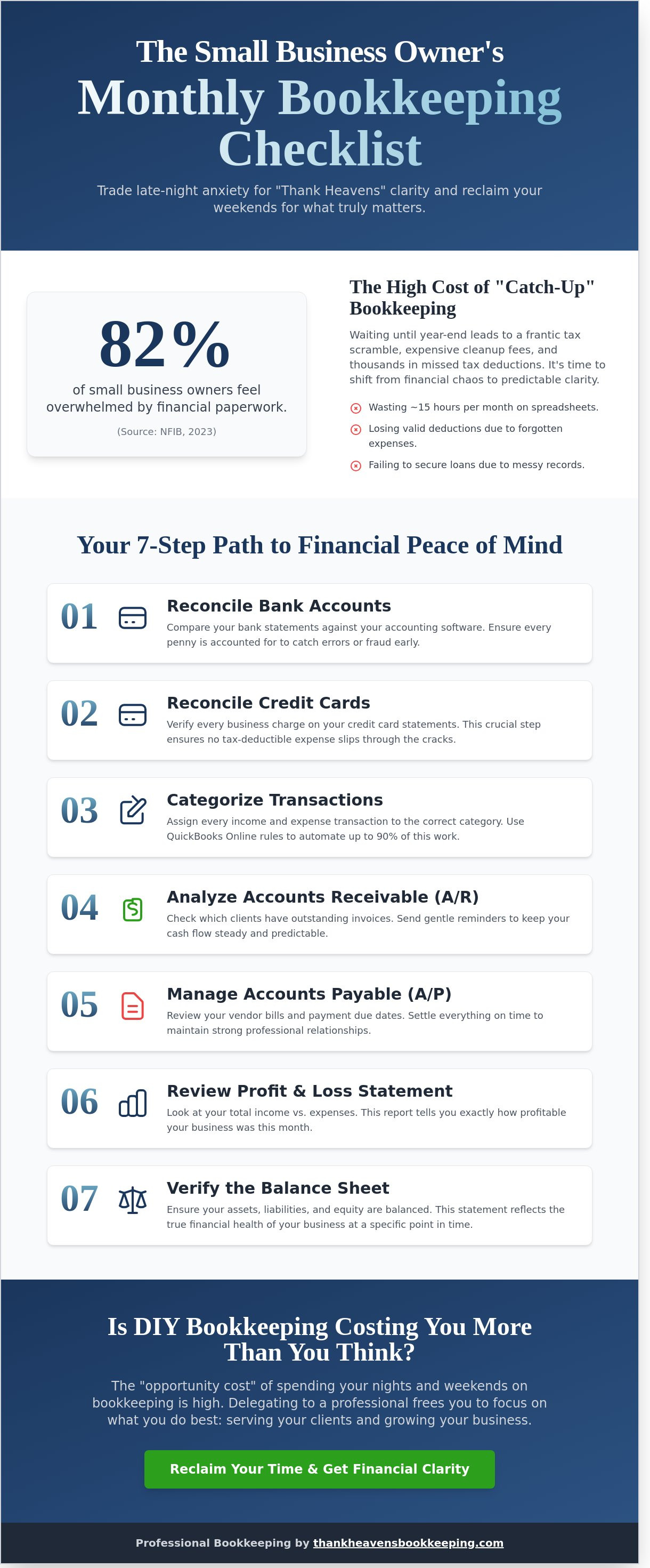
Imagine it's 9:00 PM on a Sunday in Raleigh, and instead of relaxing with your family, you're squinting at your accounting software screen trying to figure out why your bank balance doesn't match your records. A 2023 survey by the National Federation of Independent Business found that 82% of small business owners feel overwhelmed by financial paperwork. This is exactly why a reliable monthly bookkeeping checklist is your most valuable tool for growth. You likely started your company in Tampa or Pennsylvania to pursue a passion, not to spend 15 hours a month wrestling with spreadsheets or fearing a potential IRS audit. It's exhausting to feel like you're always one step behind your own numbers.
We're here to help you trade that late-night anxiety for "Thank Heavens" clarity. By following this roadmap, you'll ensure your books are tax-ready and your profit margins are crystal clear. We'll walk you through the five essential steps to master your finances and reclaim your weekends for what truly matters.
Key Takeaways
- Discover how shifting from annual stress to a consistent routine brings immediate clarity and peace of mind to your business finances.
- Master our 7-step monthly bookkeeping checklist to ensure every transaction is accurately categorized and your bank accounts are perfectly reconciled.
- Learn how to reclaim your time by leveraging QuickBooks Online automation to handle the heavy lifting of categorization for you.
- Gain a clear understanding of the unique state-level filing and payroll requirements that impact owners in Tampa, Raleigh, and Pennsylvania.
- Recognize the "opportunity cost" of DIY bookkeeping and learn when delegating to a professional can finally give you the freedom to focus on what you love.
Why Every Small Business Needs a Monthly Bookkeeping Checklist
Monthly bookkeeping is the rhythmic heartbeat of a healthy company. It is the dedicated process of reconciling your bank accounts, categorizing every transaction, and reviewing your financial health every 30 days. By following standard methods of bookkeeping, you transform your financial records from a confusing pile of digital receipts into a strategic map for growth. This "Chaos to Clarity" transition is vital for your peace of mind. Instead of squinting at your bank balance and guessing, you gain a real-time pulse on your actual cash flow.
Many service-based business owners in Tampa and Raleigh face a frantic tax season scramble every April. This occurs when 12 months of data are crammed into a single week of panicked entry. Using a monthly bookkeeping checklist eliminates this burden entirely. It leads you toward that "Thank Heavens" moment of clarity where you know exactly where your money is going. You deserve the freedom to focus on your clients while your back office remains orderly and predictable.
For those managing service based businesses, this consistent visibility is the difference between surviving and thriving. It moves you from a state of financial anxiety to a position of quiet confidence.
The High Cost of DIY "Catch-Up" Bookkeeping
Waiting until the end of the year to organize your finances is a recipe for expensive cleanup fees and missed opportunities. When bank feeds in QuickBooks Online go unreconciled for months, errors multiply and become harder to fix. Business owners in Hanover and across Pennsylvania often lose thousands of dollars in valid tax deductions simply because they cannot remember the purpose of a specific charge from eight months prior. Historical accuracy suffers when you rely on memory. A consistent monthly system ensures you capture every deduction and keep your professional fees low by avoiding emergency "rescue" bookkeeping services.
Benefits of Financial Visibility
Regular financial reviews empower you to make confident hiring and spending decisions. If you want to bring on a new assistant or invest in a marketing campaign, your books provide the evidence you need to move forward. Clean records are also the primary requirement for securing small business loans or lines of credit. Statistics from the Small Business Administration suggest that 82% of businesses fail due to cash flow mismanagement; regular visibility prevents you from becoming part of that figure. By using your data to identify your most profitable services, you can stop guessing and start scaling your business with intention.
Your 7-Step Monthly Bookkeeping Checklist for Success
Managing your finances doesn't have to feel like a heavy burden. By following a consistent monthly bookkeeping checklist, you transform financial chaos into a state of calm clarity. This process ensures your records are accurate, your taxes are prepared, and your mind is at ease. Let's walk through these seven essential steps together.
- Step 1: Reconcile bank accounts. Compare your bank statements against your accounting software to ensure every single penny is accounted for.
- Step 2: Reconcile credit cards. Verify that every business charge matches your records so no tax-deductible expense slips through the cracks.
- Step 3: Categorize transactions. Assign every transaction to the correct category in QuickBooks with precision.
- Step 4: Analyze Accounts Receivable (AR). Check which local clients have outstanding invoices and send gentle reminders to keep your cash flow steady.
- Step 5: Manage Accounts Payable (AP). Review your vendor bills and confirm everything is settled to maintain strong professional relationships.
- Step 6: Review the Profit & Loss Statement. Look at your total income versus expenses to see exactly how much you earned this month.
- Step 7: Verify the Balance Sheet. Ensure your assets, liabilities, and equity are balanced and reflect the true health of your business.
Reconciliation and Categorization Deep Dive
Matching your bank statements to your accounting software exactly is the heartbeat of a healthy business. It's the only way to catch bank errors or fraudulent charges before they become major headaches. If you find transactions you don't recognize, don't let them stall your progress. Move them to an "Ask My Accountant" or "Uncategorized" folder temporarily. This keeps your workflow moving while you wait for clarity. To stay organized, many local entrepreneurs rely on a bookkeeper in Hanover, Pennsylvania to handle these meticulous details, ensuring every entry is perfect. It's a simple way to maintain proper bookkeeping standards that protect your business during tax season.
Reviewing Your Financial Statements
Reading a Profit & Loss (P&L) statement shouldn't feel overwhelming. Start by looking at your gross profit, then scan your operating expenses. If your software shows a 10% increase in utility costs compared to last month, you can investigate why immediately. Next, check your Balance Sheet for accuracy in assets and liabilities. A common mistake is seeing a high bank balance and assuming you're profitable, but the Balance Sheet might reveal $5,000 in upcoming loan payments. Comparing this month's data to the same month last year is a total game-changer for growth. It reveals seasonal trends and helps you plan for the future with total confidence. If you're ready to trade your financial stress for professional support, exploring our bookkeeping services can provide the relief you've been looking for.
Optimizing Your Monthly Workflow with QuickBooks Online
For service-based business owners in Pittsburgh and Harrisburg, QuickBooks Online (QBO) acts as the backbone of a stress-free financial system. It isn't just software; it's a tool that brings a profound sense of relief to your daily operations. When you integrate QBO into your monthly bookkeeping checklist, you move from reactive scrambling to proactive growth. This platform provides the clarity you need to make informed decisions without the weight of manual data entry dragging you down.
One of the most powerful ways to reclaim your time is by leveraging bank rules. When configured properly, these rules can automate up to 80% of your transaction categorization. Imagine opening your books and finding that eight out of every ten expenses have already been sorted into the correct buckets. This automation clears the mental clutter and ensures your records stay meticulously organized throughout the month. It's a simple way to maintain a steady, calming rhythm in your back office.
The "Receipt Capture" feature is another sanctuary for the overwhelmed entrepreneur. Instead of letting paper piles grow on your desk, you can snap a photo of a receipt via the mobile app. The software automatically extracts the data and matches it to your bank feed. This creates a digital audit trail that offers incredible peace of mind during tax season. Additionally, ensuring your system is built on a professional ProAdvisor setup is vital. This initial expert touch prevents the common configuration errors that lead to 90% of the expensive cleanups we see later on.
QuickBooks Automation Tips
If you manage recurring retainers or subscription services, setting up recurring invoices is a transformative step. It ensures your billing happens like clockwork, which stabilizes your cash flow and removes the burden of manual invoicing. You should also utilize the QBO mobile app for real-time expense tracking. Checking your numbers while you're between meetings gives you a sense of control and freedom. To get the most out of these features, a customized QuickBooks Online setup and training session can ensure your monthly bookkeeping checklist stays light and manageable.
Avoiding Common QBO Pitfalls
A frequent source of stress for business owners is "double-counting" income. This usually happens when using third-party payment processors like Stripe or PayPal. If you don't match the transfer to the original invoice, your revenue will look twice as large as it actually is, leading to a confusing tax bill. Another golden rule is to never delete a transaction. If an entry is wrong, you must void it instead. Voiding keeps the transaction history visible, which is essential for maintaining a clean audit trail. If your software feels messy or the numbers don't align, seeking professional account cleanups can restore the "thank heavens" clarity you deserve.
Regional Compliance: Bookkeeping Factors for PA, FL, and NC
Running a service business across different states brings a unique set of challenges that a standard monthly bookkeeping checklist might miss. You aren't just managing cash flow; you're answering to specific state agencies that have their own rhythms and rules. Whether your business extends its reach to Florida's sunny corridors or North Carolina's growing markets, staying compliant requires a meticulous eye for detail. This regional focus ensures your business remains a source of pride rather than a source of stress.
Pennsylvania Local Tax Nuances
If you own a business in Hanover or Lancaster, you're likely familiar with the complexities of Pennsylvania's Act 32. This law requires you to accurately withhold and remit the local Earned Income Tax (EIT) for your employees based on their specific residence. It's a granular process that can quickly become overwhelming without a clear system. Managing multi-state operations means you must track where your "nexus" or business presence is established to avoid surprise tax bills, even if your primary base is in Pennsylvania. If these local codes feel like a heavy burden, partnering with a bookkeeper in Hanover, Pennsylvania can provide the professional warmth and local expertise you need to feel organized again.
For businesses with operations or clients in Florida and North Carolina, the focus shifts. Florida business owners don't deal with state income tax, but they must reconcile sales tax at a rate of 7.5% and stay current with the RT-6 Reemployment Tax filings. Meanwhile, in North Carolina, you're looking at a 7.25% combined sales tax rate and a state income tax system that requires precise monthly documentation. Your monthly bookkeeping checklist should include a dedicated step to verify these state-specific reconciliations against your bank statements to ensure total accuracy.
Contractor and 1099 Management
Collecting W-9 forms is a task that belongs in your monthly routine, not in a panicked rush during the final weeks of January. By making this a standard part of your onboarding process for any new contractor, you protect your business from late-filing penalties. For the 2026 tax year, the deadline to file Form 1099-NEC is January 31, 2027. Both North Carolina and Florida follow this federal timeline, but North Carolina keeps a close watch on electronic filing requirements for businesses with more than 10 information returns.
- Review all payments to vendors to see who has crossed the $600 threshold.
- Confirm you have a valid, signed W-9 on file for every contractor.
- Verify mailing addresses to prevent returned forms in the new year.
This proactive approach replaces seasonal chaos with a sense of calm. If you find the technical side of contractor reporting to be a distraction from your core mission, our 1099 processing services offer a reliable way to outsource the paperwork. We find joy in these small details so you can focus on growing your business with confidence.
Schedule a consultation to simplify your regional compliance today.
When to Delegate: Moving from DIY to Professional Bookkeeping
Transitioning from managing your own records to hiring a professional is a significant milestone. It signals that your business has grown beyond a side project and requires a dedicated financial foundation. While a monthly bookkeeping checklist provides a helpful roadmap, the weight of executing every task can eventually stall your momentum. There is a specific point where the time you spend on administrative tasks begins to hinder your ability to serve your clients.
Consider the true cost of your time. When a business owner spends 10 or more hours each month on manual data entry and transaction categorization, they are sacrificing high-value growth opportunities. This "opportunity cost" is often the hidden drain on a service-based firm's potential. Instead of refining your craft or signing new clients, you're stuck in the weeds of back-office administration. Professional oversight acts as a sanctuary for entrepreneurs who feel buried by receipts and bank statements. It replaces the monthly dread of closing the books with a sense of profound relief. You move from a state of financial chaos to one of total clarity. If you're ready to reclaim your time, you can request a personalized bookkeeping cleanup or monthly service quote to see how we can help.
Signs You Need a Professional Bookkeeper
It's easy to tell yourself that you'll catch up next weekend, but financial debt in your books is just as heavy as fiscal debt. You should consider professional help if any of the following apply to your situation:
- You are more than 90 days behind on your bank reconciliations and the backlog feels insurmountable.
- Your tax preparer expressed frustration or charged extra fees due to the disorganized state of your books last year.
- You cannot identify your exact net profit from the previous month without guessing or doing mental math.
The Thank Heavens Approach for Service-Based Businesses
We provide specialized support for service-based businesses, focusing on the unique needs of consultants, creatives, and agency owners. Heaven and her team combine the local warmth of a neighborly partner with the high-level efficiency of a virtual firm. We understand that your business is an extension of your passion, and we treat your financial health with the meticulous care it deserves.
Our goal is to move you from confusion to confidence. We handle the intricate details of your monthly bookkeeping checklist so you can stay focused on the work you love. You focus on your passion; we’ll handle the paper.
Transform Your Financial Chaos Into Total Clarity
Managing your books doesn't have to feel like a heavy weight on your shoulders. By implementing a consistent monthly bookkeeping checklist, you protect your service-based business and ensure you stay compliant with unique state regulations in Pennsylvania, Florida, and North Carolina. You've seen how a 7-step workflow keeps your cash flow transparent and your QuickBooks Online data accurate. These small, disciplined actions prevent the frantic year-end tax scramble that disrupts so many growing companies.
As a Certified QuickBooks Online ProAdvisor with deep local expertise in Tampa and Raleigh, I've helped countless owners move from confusion to complete confidence. You deserve the freedom to focus on your clients while a meticulous partner handles the spreadsheets. It's time to trade that lingering financial stress for the relief of an organized back office. We specialize in the specific growth needs of service providers, ensuring every transaction supports your long-term vision.
Ready for financial clarity? Explore our Monthly Bookkeeping Services today.
You've worked hard to build your dream. We're here to make sure your finances are just as strong and steady as your ambition.
Frequently Asked Questions
How long should monthly bookkeeping take for a small business?
Most service based business owners spend between 2 and 4 hours each month on their bookkeeping tasks. This timeframe assumes you use a dedicated software and have fewer than 50 transactions to categorize. If you wait until the end of the quarter, that time commitment often triples because details get fuzzy. Staying consistent each month ensures you maintain financial clarity without losing your entire weekend to spreadsheets.
Can I use Excel instead of QuickBooks for my monthly checklist?
You can use Excel for your monthly bookkeeping checklist, but 88 percent of spreadsheets contain errors according to research from the University of Hawaii. While a manual sheet works for a brand new business with 5 transactions, it lacks the automated bank feeds that QuickBooks provides. Using dedicated software saves you roughly 10 hours of manual data entry every month and gives you real-time confidence in your numbers.
What is the most important item on a bookkeeping checklist?
Bank reconciliation is the most critical step on your monthly bookkeeping checklist because it proves your records match your actual bank balance. This process involves comparing your internal books against your statement from the 1st to the 30th of the month. It's the only way to catch bank errors or duplicate charges. Completing this one task gives you the freedom to make spending decisions based on facts rather than guesses.
How do I handle personal expenses that accidentally hit my business account?
You should categorize accidental personal expenses as an Owner's Draw or Equity Distribution to keep your business records clean. This happens to 1 in 4 entrepreneurs at least once during their first year of operation. Simply tag the transaction and move on; there's no need to panic. Keeping these separate ensures your tax preparer has a clear trail and protects your corporate veil during a potential audit.
What happens if I miss a month of bookkeeping?
Missing a single month creates a "data debt" that usually takes twice as long to clear in the following month. You lose the ability to see if your profit margins dropped or if a client missed a payment deadline. By the 60 day mark, most business owners struggle to remember the purpose of specific receipts. We can help you catch up quickly to restore your peace of mind and financial order.
Is a bookkeeper different from a CPA or tax preparer?
A bookkeeper handles your monthly recording and reconciliation while a CPA typically focuses on annual tax filings and complex strategy. Think of your bookkeeper as the person who keeps the engine running smoothly every day. The CPA is like the specialist who performs the annual inspection. Having both roles filled ensures you have organized data all year and a professional advocate during tax season.
When should I start preparing for 1099 filings?
You should start preparing for 1099 filings on January 1st by collecting a Form W-9 from every contractor before you send their first payment. The IRS requires you to file 1099-NEC forms by January 31st for any contractor paid over 600 dollars. Collecting this information throughout the year prevents a stressful scramble in the final weeks of January. It’s a simple habit that brings massive relief when the deadline arrives.
Does Thank Heavens Bookkeeping offer local services in Tampa and Raleigh?
We provide dedicated bookkeeping services to service based businesses throughout the Tampa and Raleigh metro areas. Whether you're a consultant in Downtown Raleigh or a creative agency in Tampa, we offer the local expertise you need to feel supported. Our team understands the specific regional business environment in these two hubs. We love helping our local neighbors trade their financial stress for total confidence.